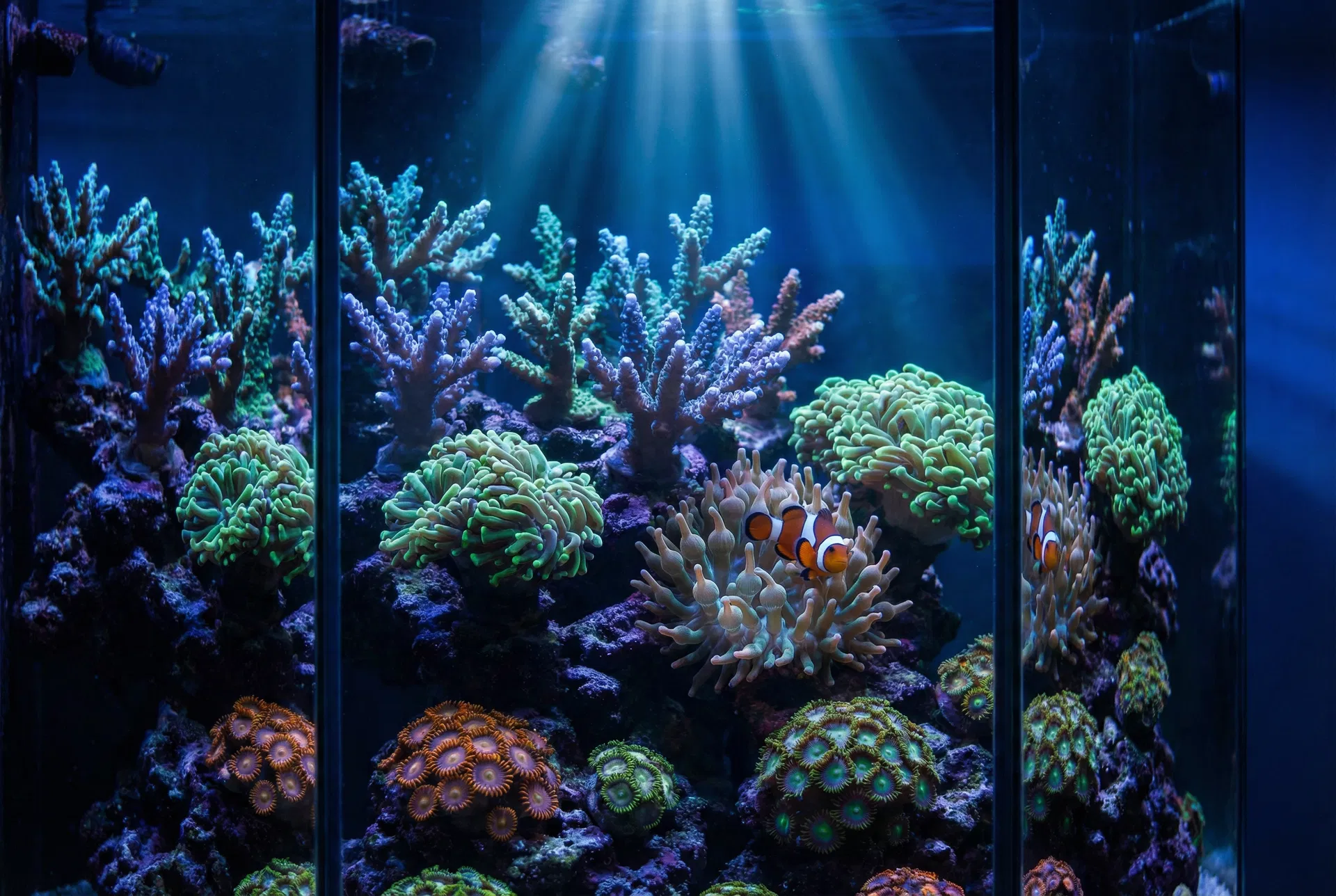
Setting Up Your First Reef Tank
Reef keeping has a reputation for being difficult and expensive. Some of that reputation is deserved. Here is what you actually need to know before you start.
Marco Delgado
Marco has maintained reef tanks for 15 years and runs a local reef club in Austin, Texas. He specializes in SPS coral propagation and aquarium photography.
Reef keeping has a reputation for being difficult and expensive. Some of that reputation is deserved — a thriving reef tank requires more attention to water chemistry, more equipment, and more patience than a freshwater setup. But the barrier to entry is lower than it used to be, and the rewards are extraordinary.
Start with the right tank size
Counterintuitively, larger tanks are more forgiving for beginners. A 40-gallon breeder or a 50-gallon display tank gives you more water volume to buffer against parameter swings. Nano reefs (under 20 gallons) are beautiful but unforgiving — a single equipment failure or missed water change can crash the system quickly. If budget allows, start at 40 gallons or larger.
The essential equipment list
A reef tank requires more equipment than a freshwater setup. At minimum, you need: a protein skimmer (removes organic waste before it breaks down), a return pump, powerheads for flow, a quality LED light with a spectrum appropriate for coral (look for PAR values and a blue/white spectrum), a heater with a controller, a refractometer for measuring salinity, and a reliable test kit for the parameters that matter in saltwater: pH, ammonia, nitrite, nitrate, alkalinity (dKH), calcium, and magnesium.
Live rock and cycling
Live rock is the foundation of a reef tank's biological filtration. It provides surface area for beneficial bacteria and, if purchased from a reputable source, comes pre-seeded with a diverse microbial community. Plan for roughly one pound of live rock per gallon of water, though quality matters more than quantity. Cycle the tank with the rock in place before adding any livestock.
Salinity and specific gravity
Saltwater fish and corals require a specific gravity of 1.025 to 1.026 (approximately 35 ppt salinity). Use a refractometer, not a swing-arm hydrometer — the latter is notoriously inaccurate. Mix your saltwater in a separate container and allow it to circulate for at least an hour before testing and adding to the tank.
Start with hardy corals
Soft corals — mushrooms, zoanthids, leather corals — are the appropriate starting point for a new reef keeper. They tolerate parameter fluctuations better than LPS (large polyp stony) or SPS (small polyp stony) corals, which require very stable alkalinity, calcium, and magnesium. Master the basics with softies before moving to more demanding species.
The reef tank is a long game. The hobbyists who succeed are the ones who test consistently, change water regularly, and resist the urge to add livestock faster than the system can handle. Patience is the most important piece of equipment you own.
Track your water parameters with MudCap AquaJournal
Log pH, ammonia, nitrite, nitrate and more — then get AI insights when something looks off.
Start free at mudcapjournal.com →