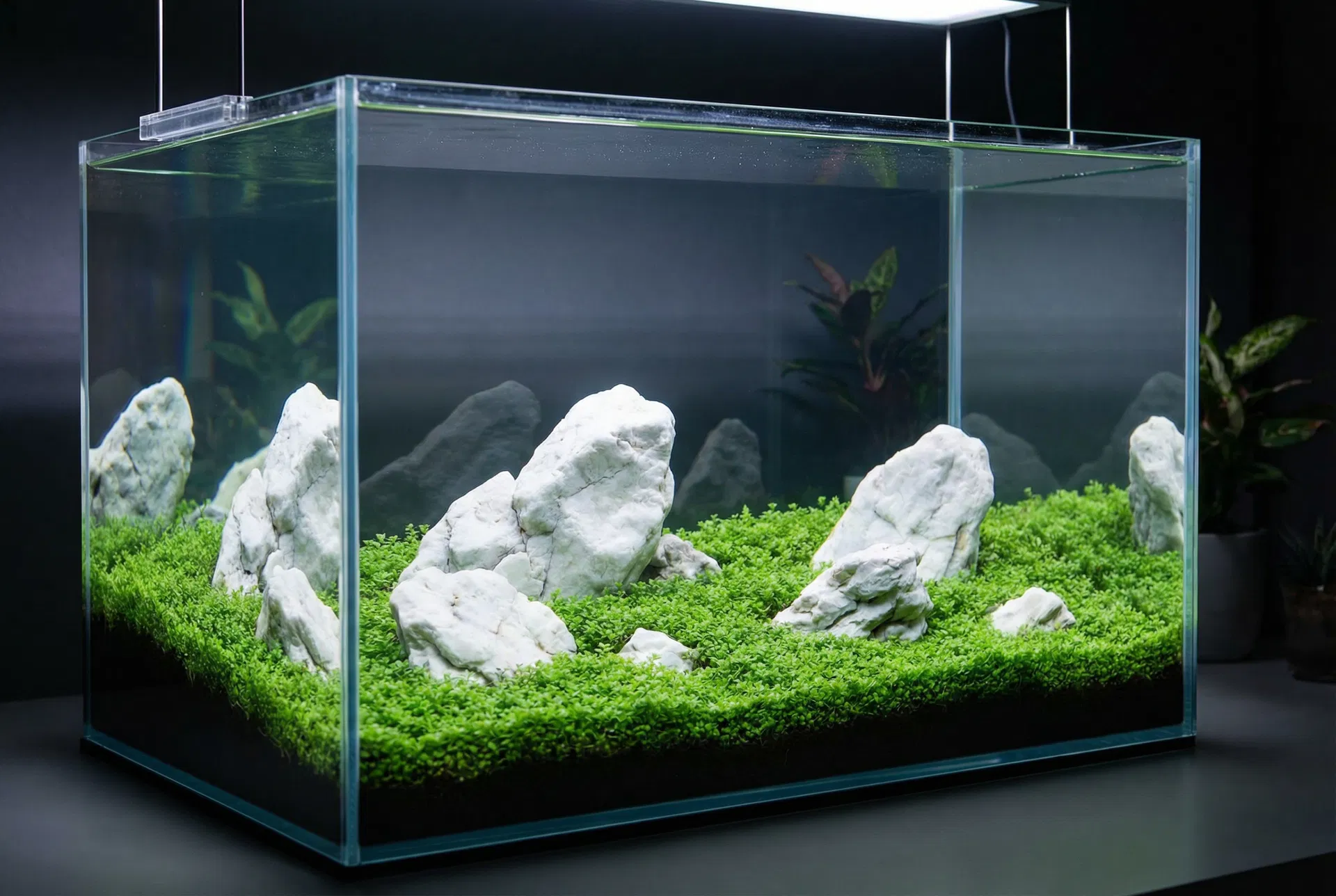
Iwagumi: The Art of Stone
The Iwagumi style strips aquascaping to its essentials — stone, carpet plants, and negative space. It is harder than it looks, and more rewarding than almost anything else in the hobby.
Yuki Tanaka
Yuki is a competitive aquascaper and ADA-certified aquascaping instructor. Her work has been featured in Aqua Journal and the ADA International Aquatic Plants Layout Contest.
The Iwagumi style strips aquascaping to its essentials — stone, carpet plants, and negative space. Developed by Takashi Amano in the 1980s, it draws directly from the Japanese garden tradition: asymmetry, simplicity, and the suggestion of a larger natural landscape within a small glass box.
The name comes from "iwa" (rock) and "gumi" (group or formation). The defining feature is a composition of stones arranged according to specific aesthetic principles, with a carpet of low-growing plants filling the foreground and open water in the background.
The stone composition
An Iwagumi layout uses an odd number of stones — typically three, five, or seven. The largest stone, called the oyaishi (parent stone), is the visual anchor and is placed off-center, roughly at the golden ratio point of the tank's width. The second-largest stone, the fukuishi (secondary stone), is positioned to complement the oyaishi. Smaller stones, the soeishi and suteishi, fill in the composition and create a sense of natural rock formation.
All stones should be of the same type and color — mixing rock types breaks the visual unity. Seiryu stone (a blue-grey metamorphic rock with white veining) is the classic choice. Dragon stone and Ohko stone are popular alternatives.
The carpet plants
The foreground carpet is typically a single species of low-growing plant: Hemianthus callitrichoides (HC Cuba), Eleocharis parvula (dwarf hairgrass), Marsilea hirsuta, or Monte Carlo. These plants require high light, CO₂ injection, and a nutrient-rich substrate to carpet properly. Without CO₂, most carpet plants will grow slowly or not at all.
The challenge
Iwagumi tanks are deceptively difficult to maintain. The minimalist composition means that any algae, any dead plant matter, any imperfection is immediately visible. The high light and CO₂ required for carpet plants also favor algae if the nutrient balance is not correct. Many aquascapers go through an "algae phase" in the first four to eight weeks of a new Iwagumi before the plants establish and outcompete the algae.
The reward for getting it right is a tank that looks like a miniature landscape — a mountain valley, a river plain, a Zen garden — rendered in living plants and stone. It is one of the most beautiful things you can create in this hobby.
Track your water parameters with MudCap AquaJournal
Log pH, ammonia, nitrite, nitrate and more — then get AI insights when something looks off.
Start free at mudcapjournal.com →